
Why a Court Translation May Be Returned in Dubai
A plain checklist for a returned court translation: confirm the forum, language, document set, identifiers, authentication instruction and delivery format.
Was a Court Translation Returned?
Send the written return note, exact court or registry, document list and current files on WhatsApp. We will separate the translation issue from any source, authentication or filing-format issue before quoting.
A returned court document does not automatically mean the translation was wrong. The problem may be the wrong language for the forum, a missing attachment, an inconsistent case reference, an authentication step that was expressly required, or the way the file was prepared for submission.
The fastest first step is not to order the same translation again. Ask for the written return reason, then match that reason to the actual document set.
For a new matter, use the court document translation service to send the receiving court or tribunal, document list, required language and real deadline before payment.
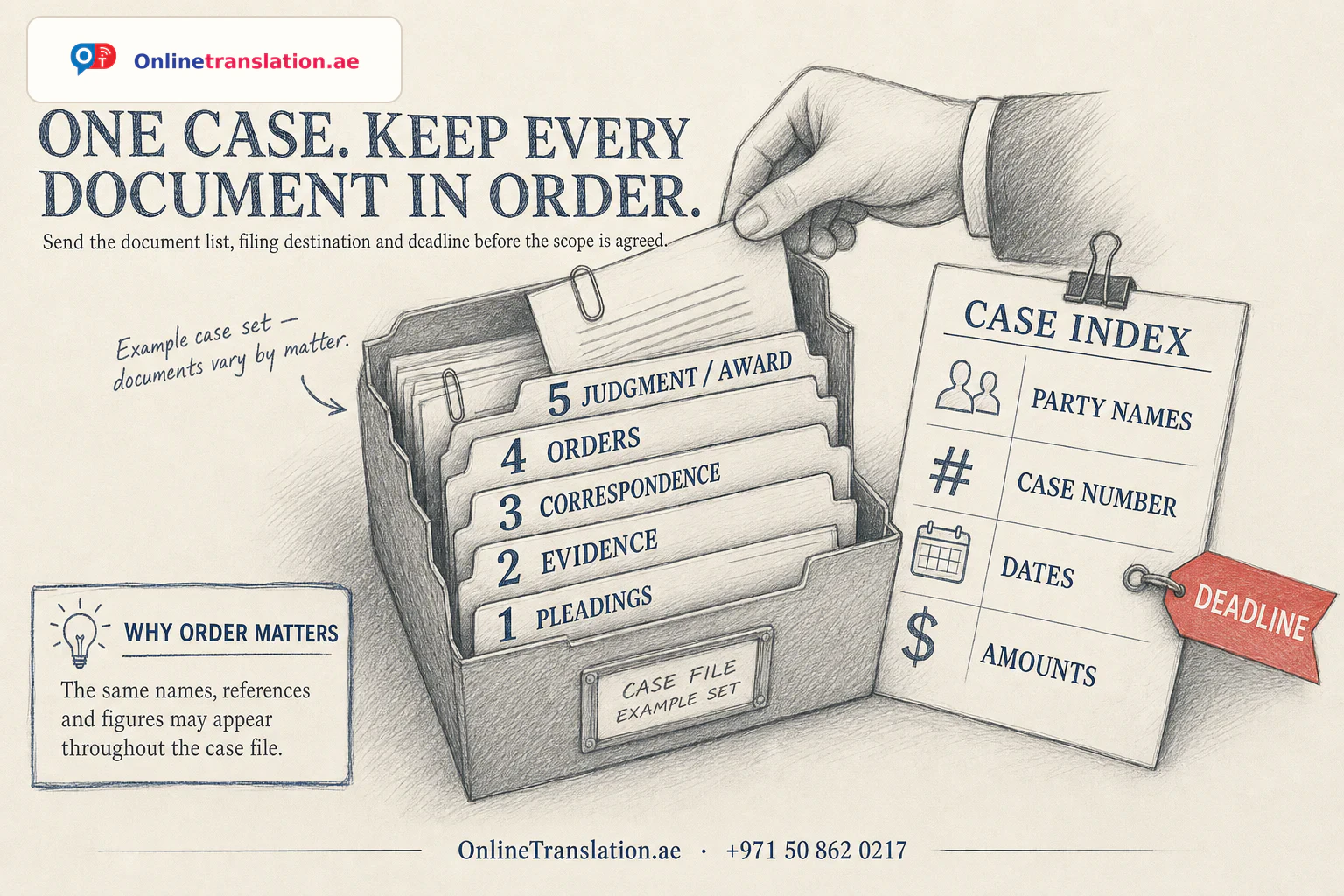
One case may contain many connected documents. Names, references, dates and amounts should not drift from one file to the next.
Quick check: five different problems can look like “translation rejected”
Before asking anyone to redo the work, identify which of these five buckets fits the written return note:
- Forum or language: the file was prepared for a different court, tribunal or registry.
- Document set: a page, reverse side, exhibit, annex or current version is missing.
- Identifiers: names, case numbers, dates, amounts or exhibit labels do not match the case record.
- Authentication: the receiving body expressly required an attestation or authentication step that is not visible in the submitted source.
- Submission format: the court or registry asked for a different file, naming convention, pagination, bundle order or delivery method.
These are different jobs. A new translation cannot repair a missing source page, authenticate an original or decide which evidence the case legally needs.
1. Confirm the exact court or tribunal first
“UAE court” is not a complete instruction.
The federal Civil Procedure Code generally uses Arabic for proceedings, while allowing English in certain designated proceedings or cases. DIFC Courts Rules 2.2–2.3 state that proceedings and documents filed or served are in English. ADGM Courts also states that its proceedings and submitted documents are in English.
That is why the provider should ask:
- Which exact court, tribunal, registry or authority will receive the file?
- What does its written instruction say?
- Which language did it request?
- Is this a first submission, an appeal, an enforcement request or a reply to a return note?
Your lawyer or the receiving forum determines the required filing set. The translation provider should not guess from the document title alone.
2. Check the complete document set
A case file is rarely one loose page. It may contain pleadings, memoranda, witness statements, expert reports, correspondence, exhibits, contracts, orders, judgments and later additions.
Compare the document list against the files actually sent. For each selected item, check:
- all numbered pages;
- reverse sides with writing, stamps or stickers;
- referenced schedules, annexes and exhibits;
- the current version rather than a superseded draft;
- readable scans with no cropped text;
- any prior translation already used in the same matter.
If the lawyer has selected only certain documents, send the full pages and attachments for each selected item. The translator may need surrounding context to understand a reference, but the lawyer remains responsible for deciding what evidence is legally necessary.
3. Keep the case identifiers connected
The same information may appear across documents received weeks or months apart. A small inconsistency can make the file difficult to follow even when each sentence is translated correctly.
Create a simple case record containing:
- party and company names;
- the case, claim or reference number;
- approved spellings used in earlier filings;
- important dates;
- amounts, currencies and percentages;
- exhibit labels and document titles;
- recurring defined terms.
When a new document arrives, say whether it adds to or replaces an earlier version. Do not silently swap files under the same name.
4. Separate translation from authentication
A translation conveys the source text. It does not prove that the source is genuine, validate a seal, verify an issuer or make a foreign judgment enforceable.
For translated documents submitted to a court or an authority carrying out authentication or certification, the UAE law regulating the translation profession generally requires fulfilment by a translator or translation house listed under that framework, subject to the law’s limited exception. That provider question is separate from any embassy, consular or UAE MOFA step.
If your lawyer or receiving authority has expressly confirmed that UAE MOFA attestation is required, complete MOFA on the original first and then send the final stamped document for translation. If nobody has asked for MOFA, do not order it from this article alone. See the MOFA-first sequence for the conditional workflow.
For a foreign judgment, Articles 222–223 of the Civil Procedure Code place recognition and enforcement questions with the competent execution judge. Translation is one component of that file, not a decision on enforceability.
5. Follow the actual submission instruction
Do not rely on a universal checklist saying that every court wants the same paper size, binding, page stamp or parallel layout. Requirements can differ by forum, service and stage of the case.
Use the current instruction from the receiving court or registry. If a file was returned, ask for the exact reason and keep a copy. Useful questions include:
- Was the problem the source document or the translation?
- Was a page or exhibit missing?
- Was the wrong language or provider credential used?
- Was authentication specifically requested?
- Did the file name, order, pagination or upload format fail a service rule?
A written reason turns “rejected” into a fixable task. A verbal assumption often creates a second unnecessary order.
Special files need their own route
Some documents sit inside a wider case file but have a distinct legal route:
- For a judgment, order or verdict, use the court verdict translation page.
- For an arbitral award, use the arbitration award translation page. Article 55 of the UAE Arbitration Law lists documents for an enforcement request under that law, including a certified Arabic translation when the award is not in Arabic.
- For a contract submitted as evidence, send the complete agreement, schedules and amendments through the contract translation page.
- For an RDC matter, use the RDC dispute-document page so the SPA, Ejari, notices, memoranda and evidence can be considered as one file.
The focused route does not decide the legal filing set. It helps keep the translation request from swallowing a separate recognition, enforcement, notarisation or evidence-selection question.
What to send before asking for a new quote
Send these items together:
- the written return note or registry instruction;
- the exact receiving court, tribunal or authority;
- the current document inventory;
- every page and attachment for the selected documents;
- earlier filed translations or approved spellings;
- the required language and provider instruction;
- the real deadline, time zone and requested delivery format.
OnlineTranslation.ae coordinates intake, project handling and delivery. Where registered UAE legal translation is required, the written quote identifies the licensed fulfilment arrangement before payment. The court, registry or authority remains the party that decides acceptance.