
Attestation vs Translation: Which Comes First in UAE?
If MOFA is a confirmed requirement, complete it before translation. Then translate the final attested document with every stamp included.
If a court, ministry, embassy, employer, bank, university or other receiving entity has told you that MOFA is required, do not translate the document yet.
Complete MOFA first. Translate the final MOFA-attested document second.
That order is fixed once MOFA is a confirmed requirement. But it does not mean every document needs MOFA. If nobody has told you MOFA is required, confirm with the receiving entity before paying for it.
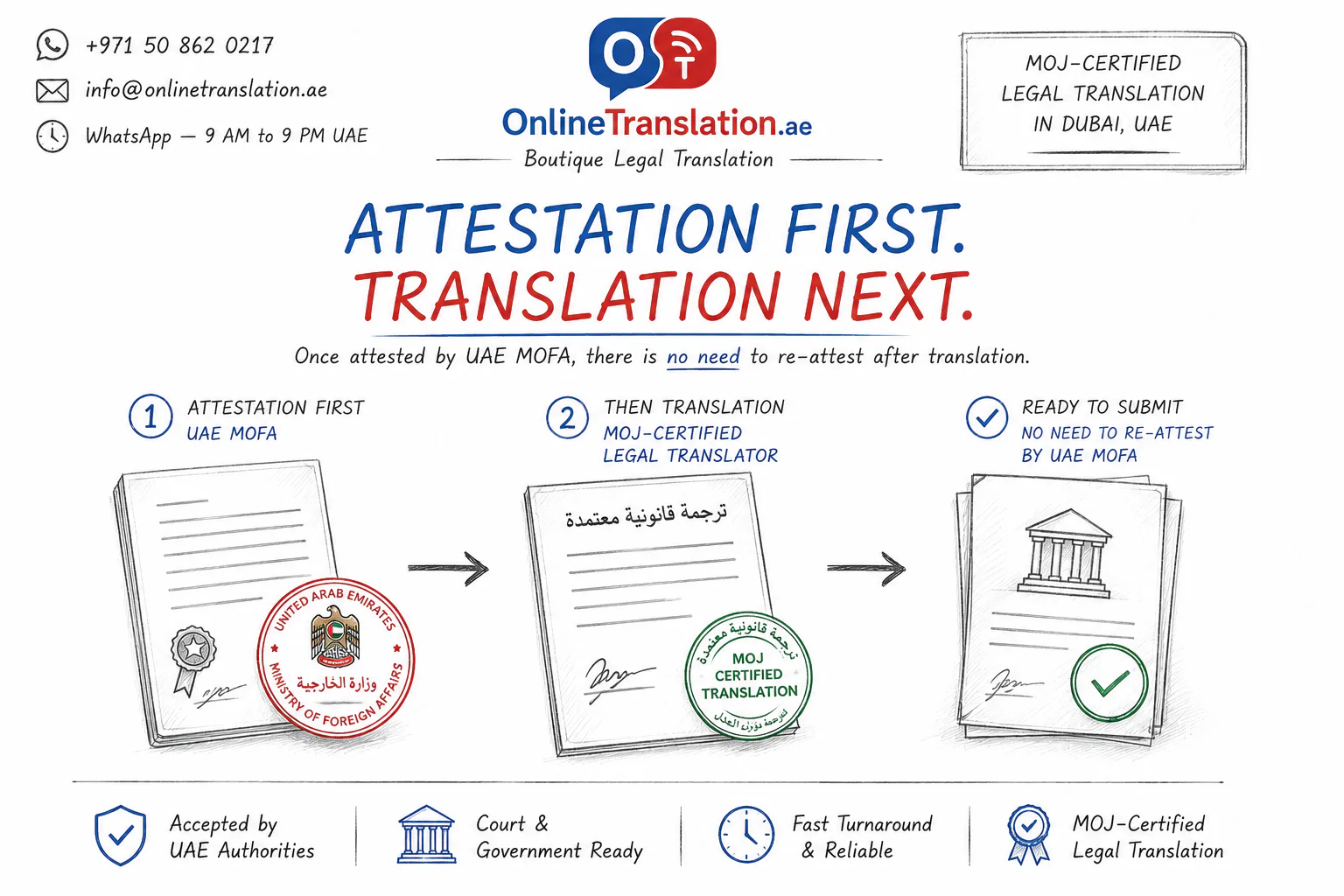
The infographic above explains the sequence. Use it only after the receiving entity confirms that MOFA is required; it is not a promise that every document needs MOFA or that every authority has identical submission rules.
Start with the receiving entity
Ask one direct question:
“Is MOFA attestation required for this document and this submission?”
- If the answer is yes: complete MOFA first, then order translation.
- If the answer is no: proceed according to the receiving entity’s other requirements.
- If the answer is unclear: ask them to confirm in writing before spending money.
The translator can explain translation scope. The translator cannot replace the receiving entity’s decision about whether MOFA is mandatory.
The correct order when MOFA is required
- Confirm the requirement. Make sure the receiving entity has actually asked for MOFA.
- Complete MOFA on the original. Finish the required attestation and wait for the final sticker, stamp or digital annotation.
- Send the final document for translation. Include every page and every side carrying a stamp or sticker.
- Receive the legal translation. The translation can now reflect the document in its final attested form.
In one line: confirmed MOFA requirement → MOFA → legal translation.
Why MOFA comes before translation
Attestation and translation do different jobs.
- MOFA attestation concerns the authenticity of signatures and seals on the document.
- Legal translation converts the document and its relevant visible annotations into the required language.
MOFA may add a sticker, stamp, reference number or other annotation to the original. If you translate first, that later material is missing from the translation.
The result is an incomplete match between the final original and the earlier translation. Depending on what changed, the translation may need an update or a fresh issue.
What if you already translated first?
Do not panic and do not automatically pay for a second translation. First, send the completed MOFA-attested original together with the existing translation.
We will compare them and tell you whether:
- The translation can be updated.
- A new translation is needed.
- No translation change is required for the intended submission.
The receiving authority still makes the final acceptance decision.
Do not order MOFA “just in case”
The strongest version of this guidance has two parts:
- When MOFA is confirmed as required, it always comes before translation.
- When MOFA is not confirmed, ask the receiving entity instead of guessing.
This avoids both common mistakes: translating too early and paying for attestation that was never required.
For the shorter decision guide, see MOFA before translation: the correct UAE order. If you are unsure which translation type the recipient wants, read MOJ legal translation vs certified translation.
To have the final document checked for translation scope, send it on WhatsApp at +971 50 862 0217. We provide legal translation; we do not perform or sell MOFA attestation.